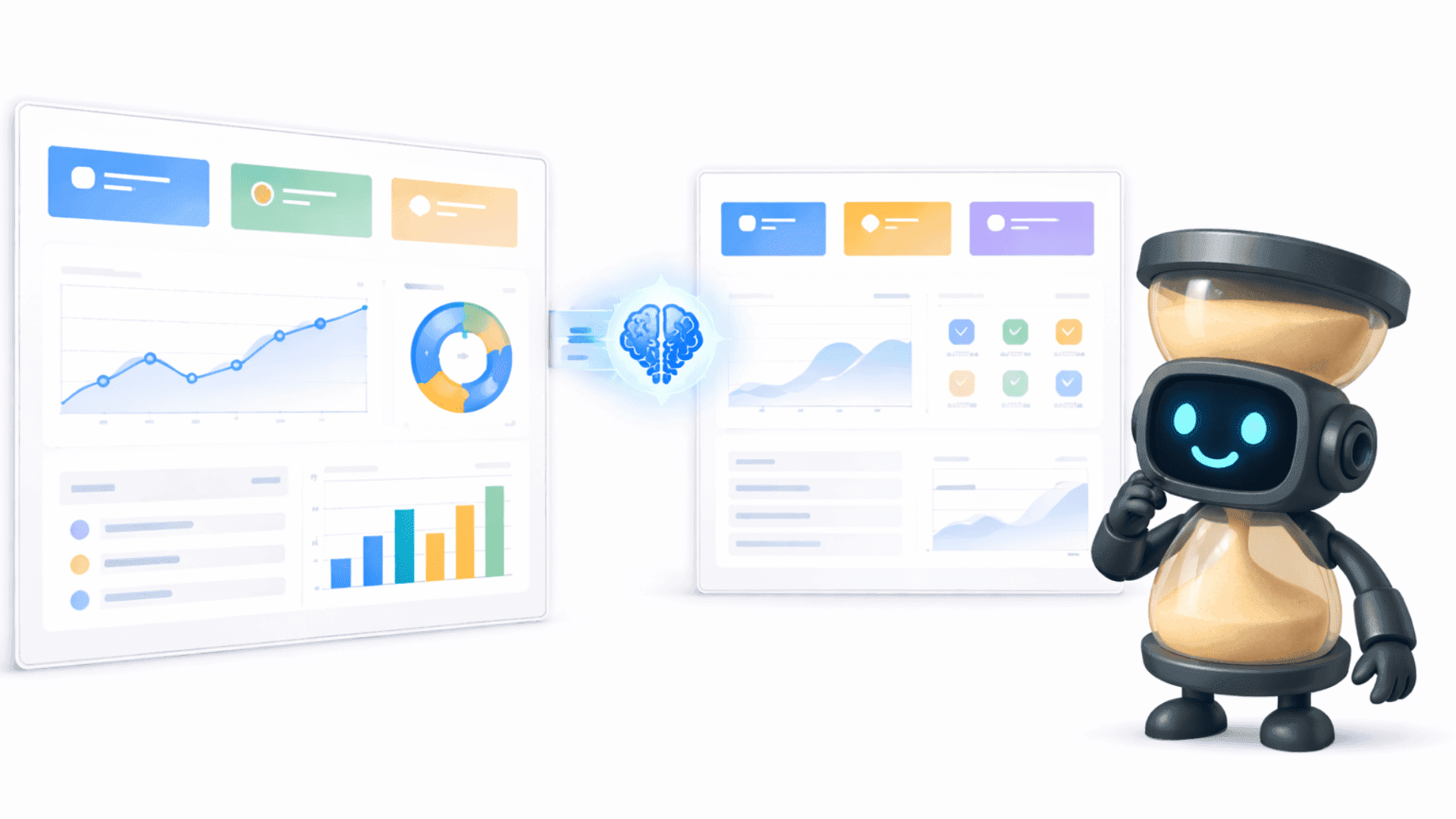
Executive Analytics in 2026: How AI-Powered Dashboards Drive 40% Revenue Growth
Data stopped being the bottleneck a while ago. Most companies already have more numbers than they know what to do with. The real issue shows up a step later, when someone has to interpret it, align teams around it, and actually make a decision.
That gap is where things slow down. And in 2026, the companies pulling ahead are the ones that removed it.
AI-powered executive dashboards are not just cleaner reporting tools. They are changing how decisions get made day to day. Faster, more direct, and much less dependent on manual interpretation. The outcome is not subtle. Execution speeds up, waste drops, and revenue follows.
Why AI dashboards fail without structure, K.B Consultancy perspective on executive analytics
Most dashboards still look impressive on the surface. Plenty of charts, real-time feeds, filters everywhere. Yet when you sit with leadership teams, the same pattern shows up. They still ask, “what does this actually mean for us today?”
Traditional dashboards fail for three simple reasons.
They look backwards. By the time insights appear, the opportunity has already passed.
They rely on human interpretation. Which means decisions depend on who is in the room, not on a consistent logic.
They try to show everything. That usually results in noise, not clarity.
At K.B Consultancy, this is where most projects actually start. Not with better visuals, but with the uncomfortable realization that the underlying structure is unclear. If your revenue drivers are not defined properly, no dashboard will fix that. It will just visualize confusion faster.
What AI-powered executive analytics actually looks like in practice
There is a noticeable shift happening. Companies are no longer impressed by dashboards that “look smart.” They expect them to behave smart.
That changes what matters.
Real-time insights are no longer optional. If your sales pipeline drops today, waiting until next week to react is already too late. AI-driven dashboards pull from live systems and surface changes immediately, without someone needing to dig.
Predictive capability is where things get interesting. Instead of reviewing last month’s revenue, leaders see where the next drop or spike is likely to happen. Hiring gaps, churn risks, even campaign performance can be forecasted with reasonable accuracy.
But the real difference is in recommendations. A strong system does not stop at showing a problem. It tells you what to do next. Reallocate budget. Shift resources. Follow up on specific leads. It narrows the decision space.
That last part is often underestimated. Reducing hesitation is just as valuable as improving accuracy.
How AI dashboards improve revenue, K.B Consultancy on decision speed and operations
Revenue growth here is not coming from a single breakthrough. It is the result of multiple small improvements compounding over time.
Decision cycles shorten. Teams spend less time debating what is happening and more time acting on it. That alone creates an advantage most companies underestimate.
Resource allocation becomes sharper. Instead of spreading budget across channels “just in case,” companies double down on what is already working, while cutting what is not. It sounds obvious, yet without clear insight, it rarely happens consistently.
Operations tighten. AI systems surface inefficiencies early. A delay in delivery, a drop in conversion, a bottleneck in onboarding. These things no longer sit unnoticed for weeks.
We have seen cases where companies believed they had a marketing problem, while the real issue was in sales follow-up speed. Without connected data and AI interpretation, that kind of misdiagnosis is common.
This is also where AI & Automation actually earns its place. Not as a layer on top, but as part of a system that continuously corrects itself.
The 40% growth effect, what actually drives it
The number sounds bold, but the mechanics behind it are not.
Conversion rates improve because teams act on the right leads at the right time.
Wasted spend drops because underperforming channels are identified early and adjusted quickly.
Operational efficiency increases because friction points are no longer hidden.
None of these changes are dramatic on their own. A few percentage points here and there. But over time, they stack.
That compounding effect is what creates significant revenue growth. Not a single decision, but a system that consistently nudges the business in the right direction.
Implementing AI-powered dashboards the right way, K.B Consultancy approach to business dashboards
Most companies approach this backwards. They start with tools, then try to fit their business into them.
That rarely works.
The starting point is clarity. Which metrics actually drive revenue? Which costs matter? Where does operational friction show up? If those answers are vague, the dashboard will be too.
Then comes integration. CRM, finance, operations, support. These systems need to talk to each other. Without that, AI insights are fragmented and often misleading.
Only after that does the AI layer make sense. Predictive models, automated recommendations, anomaly detection. These features are powerful, but only when built on clean, connected data.
This is exactly why K.B Consultancy focuses on systems first. Dashboards are not standalone products. They are interfaces built on top of how your business actually runs.
When that foundation is solid, the dashboard stops being a reporting tool. It becomes part of the decision-making process itself.
Executive analytics in 2026 is about direction, not data
The shift is already visible. Companies are moving away from collecting more data and toward using it properly.
Dashboards are no longer passive. They guide decisions, highlight priorities, and reduce uncertainty in moments where speed matters.
The gap between companies that adopt this and those that do not will widen quickly. Not because of better technology alone, but because of how decisions get made internally.
Faster, clearer, and with less friction.
That is where the real advantage sits.
22 March 2026